

Contrary to popular belief, Lorem Ipsum is not simply random text. It has roots in a piece of classical Latin literature from 45 BC, making it over 2000 years old.

Artificial intelligence has entered its industrial pilot phase. Across the global enterprise landscape, organizations are aggressively deploying hundreds—sometimes thousands—of point-solutions. We see customer support sidekicks, autonomous resolution bots, hyper-personalized marketing engines, and internal productivity assistants. Yet, as the volume of pilots grows, a foundational disconnect is emerging between technological activity and structural enterprise value.
For the modern board of directors and executive leadership team, the period of passive experimentation is over. To move past the AI hype cycle and realize actual return on investment, leaders must cross-examine their technology strategy against three uncompromising questions.

Enterprises are outstanding at describing what their AI systems do, but remarkably few can demonstrate what those systems deliver in economic terms. Volume does not equal value.
When pressed for success metrics, leaders frequently point to convenient proxies:
While these are valuable operational leading indicators, they are not structural financial outcomes. Unless an AI initiative directly impacts revenue acceleration or drives permanent cost reduction, it remains an illusion of progress. Proxies can obscure a stark reality: without strict fiscal translation, AI projects risk morphing into incredibly expensive overhead.
The mandate for corporate boards is straightforward: demand a direct translation from operational signals to the core ledger. If an AI system cannot be tied to top-line growth or bottom-line efficiency, it has not earned its place in the core enterprise strategy.

Deploying AI simply to optimize existing, legacy operations is an incomplete strategy. The deeper, more consequential inquiry centers on business model transformation. Beyond doing what the company already does—only marginally faster or cheaper—boards must evaluate how AI will fundamentally redefine the organization’s value proposition, products, and go-to-market monetization frameworks over the next decade.
True AI maturity shifts an organization from a defensive posture (cost-cutting) to an offensive posture (revenue creation). This requires evaluating how predictive models, autonomous workflows, and intelligent data layers can create entirely new vectors of market differentiation and unlock net-new revenue streams that were structurally impossible prior to the architecture of modern AI platforms.
Enterprises spent decades maturing their cybersecurity frameworks, treating digital threats as catastrophic business risks handled at the board level. Yet, many organizations currently treat AI risk as an isolated, secondary IT concern. This governance mismatch introduces severe vulnerabilities across the enterprise ecosystem.
AI risk is not a hypothetical issue; it is a complex grid of operational exposures that includes:
Platform Availability Timeline 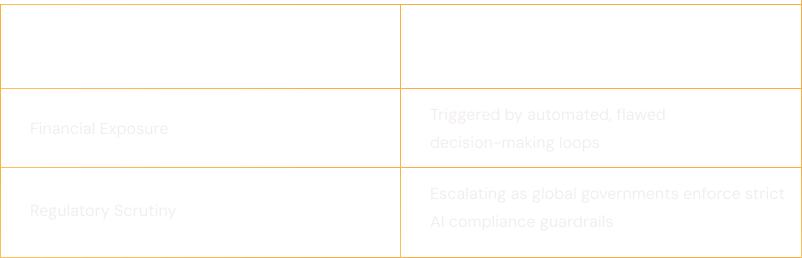
Crucially, AI risk and traditional cyber risk are becoming inextricably intertwined. Threat actors are utilizing intelligent models to compromise corporate infrastructure, while poorly governed enterprise AI deployments can accidentally expose sensitive intellectual property or create novel backdoors for data exfiltration.
Boards must mandate that AI governance frameworks mirror their cybersecurity protocols. This means establishing absolute visibility, continuous monitoring, and strict guardrails over how models ingest data, how they execute decisions, and where they interact with external networks.
As organizations look to scale their AI blueprints via platforms like ServiceNow, the role of leadership is to cut through operational noise to find financial and structural clarity. By reframing AI from a speculative IT project to a core board-level strategy—anchored in verifiable financial returns, business model innovation, and rigorous risk management—enterprises can transform expensive hype into permanent market leadership.


