

Contrary to popular belief, Lorem Ipsum is not simply random text. It has roots in a piece of classical Latin literature from 45 BC, making it over 2000 years old.

As the frequency of AI model releases accelerates, large enterprises are hitting an integration bottleneck. The prevailing market approach involves layering generic LLM APIs over siloed systems. This approach introduces significant architectural friction, forcing enterprise IT teams into continuous cycles of bespoke development to keep workflows aligned with the latest model iterations. Crucially, standalone models lack the contextual awareness required to drive complex enterprise execution; they can process text, but they cannot inherently interact with backend enterprise infrastructure.
Announced in January 2026, the enhanced multi-year strategic alliance between ServiceNow and OpenAI addresses this integration gap. By establishing an engineering co-innovation framework, OpenAI becomes a preferred intelligence capability natively embedded within the ServiceNow AI Platform. Rather than operating as an isolated, external add-on, OpenAI’s frontier models—including advanced iterations like GPT-5.2—are mapped directly into the data and governance structures where enterprise work actually runs.
The synergy of this native integration relies on anchoring external intelligence to an enterprise's established source of truth: the Configuration Management Database (CMDB).
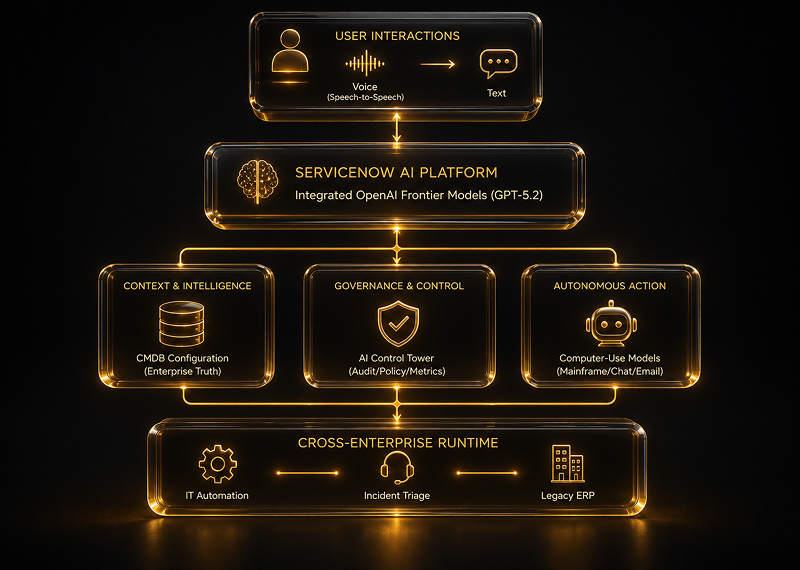
By embedding frontier intelligence directly into the runtime environment, the platform pairs contextual awareness with automated action:
This deep engineering partnership introduces two primary architectural advancements designed to accelerate real-world enterprise outcomes.
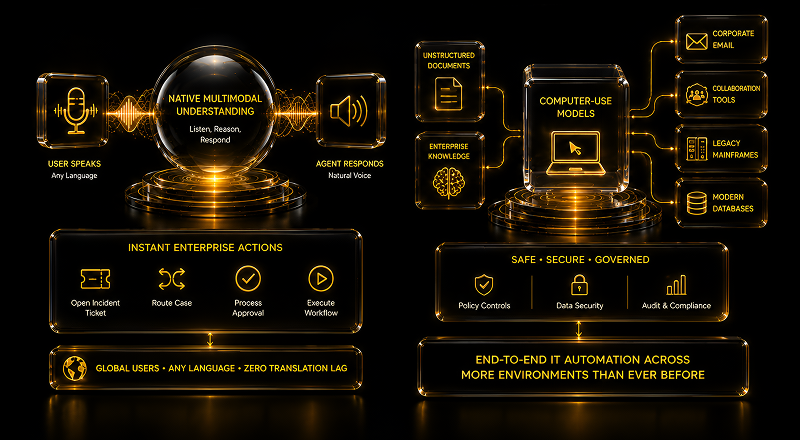
Real-Time Speech-to-Speech Voice Agents
Traditional conversational interfaces are built on multi-layered processing chains: an analog voice input is converted to text via an ASR model, processed by a text-based LLM, and then pushed back to an auditory output using a text-to-speech engine. This text intermediation degrades meaning, introduces transcription errors, and creates severe latency.
As the enterprise attack surface expands, security operation centers (SOCs) are overwhelmed by phishing attempts and system vulnerabilities. The Security & Risk AI specialists are engineered to compress investigative timelines from days to minutes. These agents autonomously triage vulnerabilities—extending down to hardware-level flaws—while screening third-party vendor risks to deliver instantaneous risk profiles. When active threats occur, they investigate and isolate the vectors while keeping human security professionals in the loop for high-consequence containment decisions.
Supercharging IT Automation via Computer-Use Models
Enterprise software environments are frequently divided between modern cloud-native systems and legacy applications, including on-premise mainframes and disconnected workplace collaboration tools.
The integration of OpenAI’s computer-use models unlocks a new paradigm of end-to-end IT automation. This capability allows autonomous agents to safely interact with software user interfaces exactly like a human engineer would. By turning unstructured enterprise documentation into structured data, these agents securely orchestrate tasks across fragmented digital landscapes—fluidly transitioning between corporate email, collaboration chat tools, legacy mainframes, and modern databases to execute resolutions across more environments than previously possible.
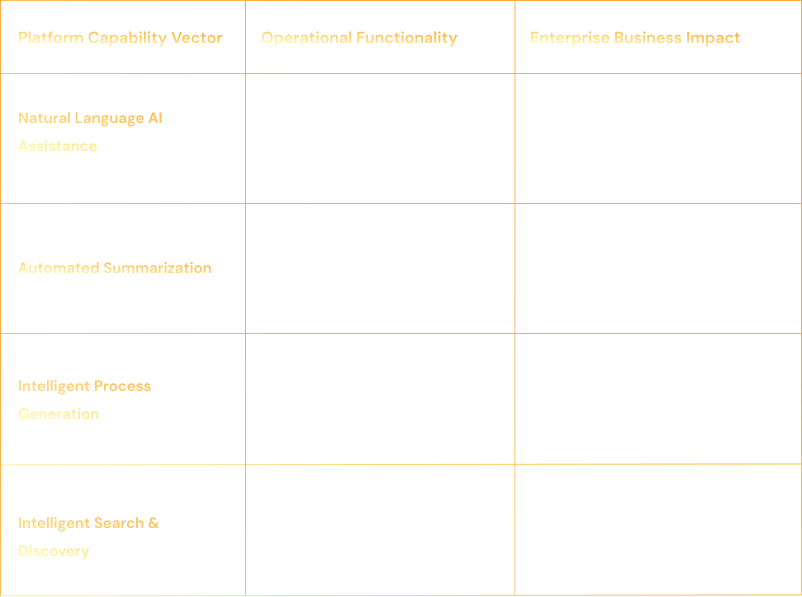
This advanced co-innovation builds directly upon an established foundation of platform capabilities that currently powers more than 80 billion workflows annually across the global ServiceNow ecosystem:
The definitive value of artificial intelligence is no longer measured by a model’s isolated intelligence quotient, but by its capacity to securely interact with the real world. By eliminating the architectural barriers dividing frontier models from backend execution, the ServiceNow and OpenAI alliance transitions the enterprise out of the experimentation phase. Mirroar leverages this unified runtime environment to help companies deploy agentic AI that doesn't just analyze data, but actively closes the execution loop across the entire enterprise landscape.


